It's true, the can had a weird image for years. Also with me. Not because of the material or taste – but because of the technology. Can filling systems were the corporate brewers’ playground. A can filler cost “millions”. For a long time there was no can filling system in Switzerland because “our market was too small for cans.” Even Coca-Cola imported cans for Switzerland from Austria in the late 1980s.
At some point, maybe 25 years ago, it started. First with cheap imported cans. Feldschlösschen was there later. The can became the USP of the corporate brewers. No small machine could keep up with the expensive, large machines. The can started the price war. So the can became synonymous with cheap beer. The opponents made a bad impression on the can. “Smells like tin”, “unhealthy” and other rumors were spread around the world.
This had a certain justification as long as tinplate was used to make cans. However, tinplate and mixed metals have been banned for years.
The “consumer interest” in cans changed a bit for the first time when large, expensive global brands like Heineken attacked the market with cans. Surely it couldn't be that bad with the tin taste? Otherwise these premium beers would hardly be on the market in cans. More and more other famous beers – Warsteiner, Becks, Löwenbräu München – entered the Swiss market via the “can monopoly”. The big Swiss breweries retrofitted. The little ones were left behind in this segment. The can became a combat item for corporations and major distributors. Consumers bought more and more - cans increasingly gained friends, despite the bad image that was said about them. The growth continues unabated to this day.
Can filling center at the Falken Schaffhausen brewery
The Falken brewery in Schaffhausen took a strategic step in Swiss canned beer history. About 10 years ago, the brewery was the first medium-sized company to purchase a medium-sized can filling system and offered its colleagues the opportunity to use it to fill their beers. A courageous step that paid off for the brewery. Well over a dozen smaller Swiss breweries benefited from the offer and had their beer canned in Schaffhausen.
The transport took place in tank trucks to the brewery's interim storage facility and from there into the prepared or printed cans. The effort was considerable - and minimal runs were still needed to make the effort worthwhile. At least many medium-sized brewers now also had a can on offer. It was the can's breakthrough on the shelf. This broke the can monopoly of the big companies. The result: sales of cans rose continuously. Today around 1/3 of beer is packaged in cans
Traveling educates
My curiosity drove me to the USA every now and then, for example to the Craft Brewer Conference. I think it was 2010 when I spotted an older woman in a corner of a microbrewery in Philadelphia, clearly filling cans at a machine. Fill cans? A woman alone?
Actually - there was a push-through device that looked like a dishwasher with a hood that filled the empty cans in the 24-carton with beer, put the lids on them and pushed them out again when full. Grandma pushed the boxes with the empty cans in and after a few minutes took out the box with the filled and sealed cans at the other end. 1,500 cans were filled per hour. I almost fell out of my shoes in amazement. “It cost $70,000,” the boss told me. «Comes from Chicago..».
Upon closer inspection, I discovered that all the precision parts, valves, controls, etc. came from Germany and Italy! The Americans bought these parts together in Europe and assembled them in Chicago in a simple chrome steel frame to form a small can filler.
While we in Europe still believed that filling cans was a complex process and only possible with large systems, the Americans “flooded” the domestic market with their small can fillers and thus pushed the cans into the primary packaging of craft beer. To the annoyance of the corporations...
Ten years later
2022 – Craft Beer Conference in Minneapolis, the first again after Covid. There were around 10 manufacturers of small can fillers in all variants at the trade fair. No wonder – 9,500 US craft brewers are a huge market for these devices. From 40,000 dollars and 700 cans per hour you get electronic controls, high-tech, flawless filling qualities. Bottled craft beer is no longer available. Only the corporations still bottle cheap standards and lights. Anything worth mentioning comes onto the market in cans.
I looked around and asked: “Europe? No, sorry." As long as the US market was not covered, manufacturers had no interest in exporting. Why go to the trouble? And if so, then certainly not to “Good Old Europe” – Asia, Japan, South America, these fast markets are in the foreground.
The time is ripe
However, things are slowly starting to turn. The US market is probably full. The first two US manufacturers are in England, Spain and Italy. There are already two devices in Switzerland - it's a question of time before these micromachines - they are now stock items and can be delivered within weeks - enable the can breakthrough for even the smallest craft beer producers.
Irony
After the Americans have already shown us with their craft beer idea what wonderful beers can be made with old European brewing traditions and how the aromatic hops can be cultivated, they are now bringing us back “our” bottling technology, adapted to microbreweries. Development workers USA – developing region Europe?
We should take a bit of a look at ourselves!
Why cans?
Can is a perfect transport and packaging vessel and not a drinking vessel. You drink craft beers out of a glass! So you have the full bouquet in your nose.
The can is lightfast - the main pest for the beer taste - and airtight. (Crown cap is liquid-tight but not necessarily airtight). The can is therefore the ideal packaging container and is superior to glass. Aluminum is tasteless. Many cans are lined with a wafer-thin, completely harmless and odorless coating.
- Aluminium is currently significantly cheaper than glass. (33cl disposable glass bottle approx. CHF .28 / can approx. CHF -.18)
- Aluminum can be melted down and reused without restriction and without loss of quality. Our cans contain 95% recycled aluminum. Aluminum recycling is much easier than glass recycling. Remelting aluminum requires a fraction of the energy as glass. The light aluminum saves a lot of energy during transport.
- Breakproof saves a lot of packaging material and postage costs during shipping.
- Break resistance prevents expensive losses due to breakage.
- Can is easier/better to store and takes up less space
- Can cools down faster (..but also warms up faster..)
- Can cylinders are easier to label than bottle shapes
- Can cylinder has more space for information and design
Handicap
The extraction of aluminum from bauxite, unless done competently and carefully or using hydroelectric power (Australia), can cause environmental damage (South America). The correct recycling of aluminum is crucial. In Switzerland this works very well with cans. The problem is rather small parts such as coffee cream toppings etc.
Feel and drinking experience
Admittedly, touching a cold aluminum can is a different feeling than the glass belly of a bottle. And one can also argue about the pouring process from the bottle with the “Gluggglugg” or silently from the can. However, it has nothing to do with the quality of the beer. It is a “learning process” for the consumer. (25 years ago nobody wanted Coca Cola from the Plaschtigg bottle...and today?)
Service
Cans are currently a “no go” in the catering industry. I mean – “question of time”. At the ***** star bar of the Hyatt in Chicago, the “Crocodile IPA” is served from a can:
– Paper lid for the ice-cold beer glass (starts..)
– Paper lid for the cold can..
– Can is opened in front of the guest and placed on the paper with a “Cheers”
The guest pours himself the beer and has the opportunity to read the extensive description on the can study.
I find absolutely nothing derogatory in this process compared to bottle service.
Theoretically, you could also simulate “serving by the glass” with the can: when the beer is poured into the glass at the buffet, the guest does not see the can. In many places this is already the case with wheat beer - you pour the bottle at the bar. Why not?
Environment – footprint
The Buwal – Federal Office for the Environment etc. – has finally given aluminum cans the second best rating, close to reusable bottles, as long as the transport there and back stays under 100 km. And far better than the rating of disposable glass bottles.
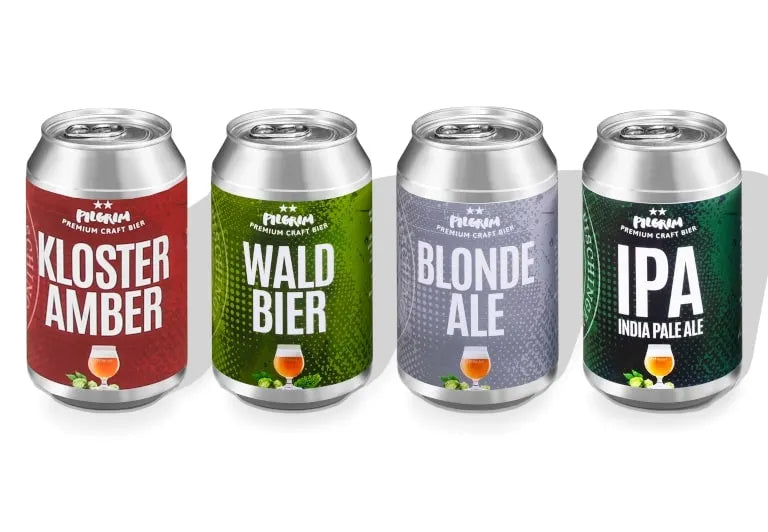
PILGRIM
We started canning our craft beers in 2022. Mobile canning – greetings from the USA – makes it possible. Two young entrepreneurs have recognized the trend and equipped themselves with a mobile can filling system “Made in USA”. They drive it from brewery to brewery and bring everything with them: cans and labellers. An old concept, previously with the schnapps distiller, today with the can filler, as can also be found in the USA for small-scale brewers. The shipping cost of cans is about 1/3 as the cost of bottles. Cans are therefore essential in e-commerce. We ship a maximum of 24 bottles (risk of breakage) or 72 cans for the same freight price. One reckons...
The collaboration with Falken now offers expanded options for processing cans. We will continue to pursue this path consistently.
We will probably stop shipping craft beer in 33cl disposable bottles over time. It is too expensive, not sustainable, waste of material at too high a cost.
Return bottles are not an issue for specialty beers: in small quantities they often go far beyond the region where there are no logistics or take-back options.
33cl disposable bottles remain "around the chimney" for the needs of the catering industry, sold in the brewery shop or wherever we go with beer crates, instead of cardboard with Planzer Logistik.
Otherwise, bottles only make sense where there is a connection with the quality of the products, for example through bottle fermentation and maturation, such as triples and grand crus. Or where the ratio of the price of the contents to the price of the container does not play a role or the appearance is important. For example, champagne in cans will hardly ever work. Just because of the “pop” of the cone. Just as our oak barrel-aged Grand Crus will never end up in cans.

Martin Wartmann, beer brewer