Beer knowledge

PILGRIM barrique beer cheese
A Swiss premiere: PILGRIM brewing art meets Toggenburg organic milk After a long search, trips to Belgium and intensive tinkering, it is finally here: the PILGRIM Barrique Beer Cheese - a symbiosis of deep black, wooden barrel-ripened Imperial Russian Stout with 14% Alc and the finest Toggenburg organic milk. In Switzerland, beer cheese is usually rubbed with a standard beer with around 5% alcohol. Afterwards, you won't notice much of the beer. PILGRIM, the monastery brewery, now goes one step further and is based on the centuries-old tradition of the Belgian Trappist monasteries: Here the best and strongest beer from the Trappist brewery comes directly into the milk in the mostly monastery's own cheese factory. When and how much is top secret. What sounds simple in theory is a technical challenge. A lager would simply be lost in the cheese. Here you need beers with character, body and good percentages. And cheesemakers who know how to do it... The perfect liaison: PILGRIM Barrique & Neuwies-Käserei Beer brewer Martin Wartmann found - with the help of AI, of course - the ideal partner for this venture in Toggenburg cheesemaker Philipp Müller (Neuwies-Käserei, Lütisburg). After an intensive tasting of the PILGRIM range, the choice fell on a beer legend from the PILGRIM monastery cellar: Imperial Russian Stout (IRS). This deep black Imperial Grand Cru matures for many months in old whiskey barrels and has a proud 14% alcohol. The roasted notes from the black malt and the fine woody smoky note of the whiskey combine in the cheese to create a wonderful taste experience that resonates subtly in the finish and - as they say - "just makes you want to take the next bite." Exclusivity in 350 gram format The start of sales showed that the combination of Toggenburg organic milk and the monastic art of brewing is in tune with the times: the first batch of the handy Mutschli, which weighs approx. 350 grams, was sold out within a very short time. Resupply secured Käser Müller has now followed up. PILGRIM Barrique Beer Cheese is available again in the brewery shop in Fischingen and in the online shop at www.pilgrim.ch. There you will also find a selection of fine PILGRIM beers that go perfectly with the new cheese. From the beginning of 2026, distribution in the region will be expanded. The cheese professionals from NATÜRLI Zürioberland AG will be adding beer cheese to their range. This makes it available to specialty and cheese shops and their customers in Eastern Switzerland. Whether as a highlight with a piece of fresh bread with the right abbey beer, on the cheese platter with a snack or from the cheese cart as a dessert - PILGRIM Barrique Beer Cheese is proof that you can do much more with really good beers than just quench your thirst. In times of declining beer consumption, the beer cheese is also an exciting regional addition to the brewery's range, which helps to make the brand name PILGRIM appealing to connoisseurs. For questions Brauerei Kloster Fischingen AGwww.pilgrim.chmartin.wartmann@pilgrim.ch079 414 41 70
PILGRIM barrique beer cheese
A Swiss premiere: PILGRIM brewing art meets Toggenburg organic milk After a long search, trips to Belgium and intensive tinkering, it is finally here: the...

Pilgrim Brewery: Good beer needs maturity
Martin Wartmann makes long-lasting Grand Cru beers that are also wine alternatives. How high is the demand? Inventor of the “Ittinger Klosterbräus”. Martin Wartmann is a master of all trades, or rather, all beers. The 78-year-old learned the brewing trade in Frauenfeld 60 years ago and worked for a time for the Heineken Group. He was the “inventor” of the now legendary Original Ittinger Klosterbräus, which introduced the Swiss to the malty amber style. Since 2015, the senior brewer has been brewing “Pilgrim” hop juices with a team of seven in the Fischingen TG monastery. Some with double-digit alcohol content, some with barrel aging. And Wartmann is convinced that such beers should increasingly be served in upscale restaurants. “Triple Ambrée” instead of a light Pinot. His secret weapon: the “Bière d'Abbaye Triple Blonde” with around ten percent alcohol: “A perfect alternative to the Cüpli or white wine,” says Wartmann. It goes well with white meat or fish. “You can even use it to deglaze risotto or prepare a fondue!” Another beer that is bottled in 3.5 dezi, 7 dezi and magnum bottles with champagne corks is the “Triple Ambrée”: it goes well with the meatloaf with beer sauce and potatoes, as it is served this lunchtime in the monastery’s restaurant. “Excellent instead of a light Pinot Noir,” says the brewer. A very dark beer is also exciting: the “Chili Stout”, which has an aroma that is slightly reminiscent of coffee, has a noticeable spiciness and can be easily imagined with Asian specialties. It matured for several months in a whiskey barrel that last contained hot sauce. Where are the 70 barrels of “Pilgrim”? Fits Perfect with monastery beer: homemade meatloaf with potatoes. The Pilgrim beers are brewed in the idyllic Benedictine monastery in Fischingen. 17.2 percent! The strongest beer in Switzerland. A few stony steps lead down from the monastery courtyard to the barrel cellar, where the wines of the Benedictine monks used to rest. Not only does the supposed “patron saint” of brewers, Gambrinus, watch over here in robes, but here are also the impressive barrels in which the so-called Grand Cru beers lie dormant. These are numbered limited editions: For example, a “Triple Blonde” with forest herbs comes into the tequila barrel. Or the beers mature in cognac barrels and carry vintages, which is popular with men who have just become fathers and want to put a long-lasting specialty on the side. The shelf life is almost unlimited: “We note on the label of the vintage Grand Crus that they can be enjoyed until 2099.” Unforgettable: the 2019 with 17.2 alcohol, which according to Martin Wartmann is still the strongest beer ever brewed in Switzerland. A collector's item! "We no longer go above 15 percent - because we don't want to pay liquor tax for a beer." Gambrinus, “Patron saint” of beer brewers, watches over the barrels in Fischingen. Thanks to the The enjoyment of beer can be celebrated with a champagne stopper. Also has the legendary Ittinger Klosterbräus “invented”: Martin Wartmann, here in Fischingen. Cheese, pralines, fondue - everything with beer. When he is offered a special barrel - for example one that was previously filled with walnut syrup - Wartmann almost can't say no. Buy it, fill it with beer. Because he is a man of many projects: His beer cheese is special, for which the Imperial Russian Stout is added to the milk before the rennet at the Neuwies cheese dairy (Lütisburg SB). Or the pralines that were made together with the Voland confectionery in Bauma ZH. It's hardly surprising that "Pilgrim" also has a beer fondue in its range in winter. Exchange is a must: Martin Wartmann (m.) in conversation with two employees in the brewery. Tasting is fun: Martin Wartmann takes a beer sample from a port wine barrel. The Pilgrim cheese has a very subtle beer note in its taste. Popular with cyclists and other monastery visitors: The brewery shop. The blessing from the gastro pope. What Martin Wartmann just can't quite manage to do is place his beer in upscale restaurants. And he can't really explain why: "It shouldn't be the carbon dioxide, because it's not too pronounced and well integrated." With a smile, the brewer remembers a conversation he had with the legendary GaultMillau editor Silvio Rizzi over 30 years ago. He admitted at the time that it really wasn't appropriate for a points restaurant to just have a large "lager" from a large brewery on the menu. For Rizzi, there were certainly dishes that were accompanied by hop juice. These include salads and other dishes with a high vinegar content that hardly go well with wine. But these are also bitter and spicy dishes. “The problem was already recognized thirty years ago.” No time to grow old. How does Wartmann himself feel about beer? After more than half a century in the industry? “I drink the last beer of the week on Saturday and the first on Tuesday,” he says. He and his wife never drank alcohol at home, also to be a good role model for their three (now grown) children. Is the weekly beer break perhaps his secret as to why he is still so fit and agile? He says: “Thanks to my work at Pilgrim, I haven't had any time to grow old. I take my health as part of my fee here.” In other words: he's still far from comfortable. Cheers to that! >> www.pilgrim.ch
Pilgrim Brewery: Good beer needs maturity
Martin Wartmann makes long-lasting Grand Cru beers that are also wine alternatives. How high is the demand? Inventor of the “Ittinger Klosterbräus”. Martin Wartmann is...

Tonka bean in winter beer
Aperitif: Farmhouse Pumpkin Ale or forest beer with vegetable dips The tonka bean is the seed of the fruit of the tonka bean tree (Dipteryx odorata), a tree up to 30 meters high that is native to the tropical areas of Central America and northern South America (e.g. Venezuela, Guyana, Amazon region). The floral-sweet taste of the tonka bean is very complex. The aroma is most reminiscent of a mixture of vanilla, marzipan, caramel and rum The tonka bean is dosed sparingly like nutmeg. You rub the beans into liquids with a nutmeg grater or cook them and take them out again It is used for desserts and especially for panna cotta, crème brûlée, rice pudding, ice cream, chocolate, cakes, cookies and sweet pastries - and in PILGRIM winter beer. Tonka beans contain the natural flavor and fragrance coumarin, which can be harmful to health in high doses. It is also said to promote libido. Use in the EU is only permitted if certain maximum values in the food are not exceeded. This is harmless under normal use. The tonka bean is an expensive spice. The price varies depending on quality, provider and quantity between CHF 150.00 and CHF 300.00 per kilo - or even more. PILGRIM is the only brewery that uses this exclusive spice in beer. The winter beer is very popular. Many fans are eagerly waiting for it to be available again at the beginning of November.
Tonka bean in winter beer
Aperitif: Farmhouse Pumpkin Ale or forest beer with vegetable dips The tonka bean is the seed of the fruit of the tonka bean tree (Dipteryx...

The PILGRIM Triples 4-course beer & dine
Aperitif: Farmhouse Pumpkin Ale or forest beer with vegetable dips Course: Starter - light fish or vegetablesBeer accompaniment: PILGRIM abbey beer Triple BlancheThe beer: Deep gold, fruity, orange note, mild. Goes well with fish, white meatFood suggestion: Fried zander fillet on fennel and orange salad.The fine citrus and orange note of the Blanche harmonizes perfectly with the fennel and orange in the salad and the light fish. The mildness of the beer does not mask the fish. Course: Intermediate course - creamy soup or light main courseBeer accompaniment: PILGRIM Abtebier Triple BlondeThe beer: Dark gold, aromatic, fine citrus note, little hop, fine sweetness.Alternative to light White wineFood suggestion: Pumpkin or leek risotto, possibly with salmon strips.The aromatic complexity and citrus note of the blonde forms a nice contrast to the creaminess of the risotto and the sweetness of the pumpkin. Blonde is stronger than Blanche and can therefore carry the fuller flavor. (Prepare risotto with 50% bouillon and 50% Triple Blond) Course: Main course - strong meat dishBeer accompaniment: PILGRIM abbey beer Triple AmbréeThe beer: Amber-colored, malty, dried fruit note, mild. Alternative to light red wine, goes well with red meat.Food suggestion: Braised beef patties, beef entrees or pink roasted saddle of veal with potato gratin and caramelized chicoryThe malty sweetness and slight dried fruit note of the ambrée go perfectly with dark, strong meat. It offers a wonderful balance to the spice of the meat and the slightly bitter notes of the chicory. Course: Dessert - chocolaty and intenseBeer accompaniment: PILGRIM Abbey beer Triple NoireThe beer: Black, roasted, caramel and cocoa notes, mild bitterness.Dessert suggestion: lukewarm chocolate cake with Dried plum parfait or vanilla ice cream.The intense roasted and cocoa notes of the Triple Noire are perfect for chocolate desserts. The beer complements the chocolate and the fruitiness of the prunes. The mild bitterness and slight acidity balance the sweetness of the dessert. You can find the four matching abbey beers PILGRIM Triples here:The famous four 75cl – PILGRIM
The PILGRIM Triples 4-course beer & dine
Aperitif: Farmhouse Pumpkin Ale or forest beer with vegetable dips Course: Starter - light fish or vegetablesBeer accompaniment: PILGRIM abbey beer Triple BlancheThe beer: Deep...
SEASONAL BEER FESTIVAL
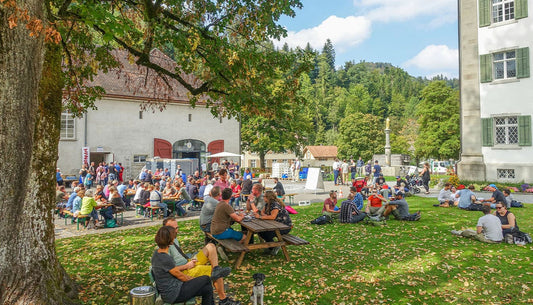
Saturday, September 13, 2025, from 11 a.m. to 4 p.m. We're doing it again - the Autumn Beer Festival! Come by and experience the world of PILGRIM: at the Fischinger Klosterhof Try 20 PILGRIM beers for free Try the Pumpkin Ale 2025 Discover the new limited editions Try Grand Crus GOLDFISCH and BLACKFISCH Enjoy raclette from NATÜRLI Take a look into the 300-year-old barrique cellar Take advantage of a 20% discount in the brewery shop Win a valuable prize in the competition Take part in the monastery tour (12.30 p.m.) Meet nice people and talk to the brewers Find out what's going on with the monastery brewery Take a look at the monastery church and visit St. Idda Admission CHF 10.00 plus your email address.In return you get your glass and three chips for 3 x beer enjoyment.Save the date - the PILGRIM team is looking forward to seeing you!
SEASONAL BEER FESTIVAL
Saturday, September 13, 2025, from 11 a.m. to 4 p.m. We're doing it again - the Autumn Beer Festival! Come by and experience the world...

Gourmet tips
Discover the diverse world of Pilgrim beers! Each of these special beers offers a unique taste experience that can be wonderfully combined with the right food. Find your personal favorite harmony. Pilgrim Biere d'Abbaye Triple Blonde and Blanche (10% Alc) A light, tangy beer with complex fruitiness and spicy notes. Dry yet elegant – ideal for light moments of enjoyment. Light meat dishes: fried chicken or turkey Fish & Seafood: Steamed fish, shrimp or mussels Creamy pasta: light, not too heavy sauces Mild cheese: goat cheese or young Gouda Fruity desserts: lemon tart or apple pie Pilgrim Biere d'Abbaye Triple Ambrée (10% Alc) Slightly darker and deeper in taste - this triple seduces with caramel and malty notes, often accompanied by a hint of dried fruits and spices. Roast pork Grilled meat: Steaks or strong sausages from the grill Game dishes: hare or wild boar Ripe cheeses: Mature cheddar or a strong mountain cheese Chocolate desserts: chocolate cake or brownies Pilgrim Biere d'Abbaye Triple Noir (10% Alc) This dark, rich and complex beer boasts aromas of dark fruit, caramel, chocolate and sometimes coffee. Braised beef Game dishes with dark sauces Smoked meat Blue cheese Rich chocolate desserts Pilgrim Wood Barrel Matured Imperial Russian Stout (14% Alc) A very dark, strong and intense beer with pronounced roasted aromas of coffee and chocolate. Grilled red meat: steaks, leg of lamb or ribs Game dishes with rich sauces Braised dishes: beef or oxtail Ripe, strong cheeses: Gouda, Emmental, blue cheese Chocolate desserts: lava cake, mousse, tiramisu Coffee desserts: Everything with coffee content Pilgrim barrel-aged Belgian Blonde (14% Alc) The barrel aging adds additional depth to this already complex beer with notes of vanilla, caramel, roasted aromas and often nuances of the barrel contents such as whiskey or rum. Enjoyment tips: Choose dishes with similar intensity and flavor complexity. Make sure that beer and food complement each other and do not overlap. Strong cheeses: ripe Gouda, Parmesan, Cheddar, mild blue cheese Meat & Game: Boeuf Bourguignon, pork belly, roast wild boar Poultry & fish: duck breast with fruit sauce, grilled salmon Desserts: Caramel desserts: crème brûlée, pecan pie Chocolate: milk chocolate lava cake, mousse Fruity: apple cake with cinnamon, pear Helene Nutty: walnut cake, almond cake I hope these suggestions inspire you to discover the perfect beer and food pairings! Which beer will you try next?
Gourmet tips
Discover the diverse world of Pilgrim beers! Each of these special beers offers a unique taste experience that can be wonderfully combined with the right...

Bitter substances in beer: Why bitterness is more important than you think
Praise the bitter substances Opinions differ when it comes to the bitterness in beer. As is well known, it comes from the ancient cultivated plant hops. Some like them, but many reject bitter beers. This is typical of our civilization today: Our softened palates and taste buds love sweets and reject bitters. This used to have a clear logic: bitter substances have warned us about inedible or poisonous plants for thousands of years. But since we have long since left the Stone Age in terms of nutrition, it is time to deal with the positive properties of the bitter taste. Research has long known many excellent health and nutritional benefits of bitter substances. Bitter substances – underestimated and important Sweet, fatty and salty flavors dominate our diet. But bitter substances play an important secondary role that is often not consciously noticed - but without them the overall impression of a dish would be lost. They can be found, among other things, in vegetables, salads, herbs, cheese or certain cooking oils. In drinks they are typical for beer, coffee, tea, herbal liqueurs or tonic water. Learn bitterness The trend in recent years has unfortunately been towards reducing bitter substances. The reason for this is people's high sensitivity to bitter things. There are big differences – both in individual taste receptors and in the perception of different bitter substances. The thresholds are often 100 to 1000 times lower than for sugar or acid. So we react much faster to bitter things than to sweet things. The experts differentiate between super styli (very sensitive), styli (average sensitivity) and non-styli (barely sensitive). The latter are “bitterly blind”. This actually exists - just as there are people who are immune to spiciness in food. Bitter substances and health Science links individual sensitivity to bitterness with a number of health aspects: for example, the tendency to be overweight, chronic inflammation, Alzheimer's or other diseases in which bitter substances could have a more protective effect. All of these are good reasons to be more aware of your own sensitivity to bitterness and to train it. Beer is ideal for this because it contains – thanks to hops – a variety of different bitter substances. Bitterness in beer – origin and effect In conventional light beers, the bitterness comes primarily from the alpha acid of the hops, which dissolves when the wort is boiled. During dry hopping, in which hop pellets are added to the maturation tank, additional aromatic substances and other bitter substances enter the beer - which makes the taste even more complex. While aromas are difficult to measure, bitterness can be quantified relatively easily: A lager contains around 10-20mg of iso-alpha acid A pilsner or bitter ale about 20-30mg A cold hopped IPA easily 30-60mg The substances responsible for bitterness, the so-called humulones, are converted into iso-alpha acids by isomerization (cooking) during the brewing process. Hop aroma ≠ bitterness The bitterness has only a limited connection to the hop aroma, i.e. the actual taste. This comes from hop essential oils – volatile substances that are extremely sensitive to heat and aging. That's why hops are pressed into pellets and packed airtight. There is a wide range of hop varieties available today - many with intense citrus, herbal or tropical fruit aromas. The aroma can be preserved in the best possible way through targeted selection and brewing techniques such as late addition of hops or cold hopping. Learn to enjoy bitterness It's worth getting involved with the bitterness - because it forms an exciting counterpart to the sweetness. It gives the beer a crisp freshness, stimulates the palate, ensures a clean finish and improves the mouthfeel. When combined with food, it enhances the aroma and supports digestion, especially with heavy dishes. Perception is subjective, but can be trained. Once you've experienced the benefits of hop bitterness in a good IPA, you won't want to be without this style - especially on hot days. Conclusion Bitterness is much more than an unpleasant taste.It is a complex element that significantly shapes the balance, aroma, mouthfeel and identity of a beer - and thus contributes significantly to the enjoyment experience.
Bitter substances in beer: Why bitterness is more important than you think
Praise the bitter substances Opinions differ when it comes to the bitterness in beer. As is well known, it comes from the ancient cultivated plant...

Brewers shaped American politics
The close relationship between beer brewing and US politics The relationship between brewing and American politics is deeply rooted in history - particularly through the role of German immigrants who significantly shaped the American brewing industry in the 19th century. Many of them became influential entrepreneurs and politicians. Samuel Adams (1722–1803), one of the founding fathers of the United States, was already a brewer. George Washington, the first president of the USA, and Thomas Jefferson, the third president, were also enthusiastic beer brewers. Numerous senators maintained close relationships with the breweries of their time. Senator Yuengling, for example, founded the D. G. Yuengling & Son brewery in 1829 - today the oldest continuously operating brewery in the USA. In 1873, Adolph Coors founded the Coors Brewing Company in Boulder. The Coors family has been politically active for generations - son Joe Coors, for example, was an advisor to President Ronald Reagan. The names Adolphus Busch and Eberhard Anheuser are also inextricably linked to American brewing history. They founded Anheuser-Busch, now part of AB InBev, the world's largest brewing company. Their political influence was particularly felt during the Prohibition era - particularly with regard to alcohol laws and trade regulations. Jimmy Carter, an avowed beer lover, liberalized alcohol laws in 1978: home brewing was allowed again. He is an honorary member of the American Homebrewers Association. Under Barack Obama, a small home brewery was even set up in the White House. White House Ale and White House Honey Brown Ale were very popular - Obama had the recipes made public. The honey for the Honey Brown came from Michelle Obama's bee garden. Samuel Adams' grave at the Granary Burying Ground in Boston Donald Trump, on the other hand, apparently had little to gain from the beer. Maybe a nicely hopped IPA would have benefited him? Because beer brewers are known to be lovable, intelligent and balanced people. Maybe that's exactly what the White House is missing today - a little more beer?
Brewers shaped American politics
The close relationship between beer brewing and US politics The relationship between brewing and American politics is deeply rooted in history - particularly through the...

Our future
Tradition meets innovation: Kloster Fischingen Brewery is looking for partners for the future The Brauerei Kloster Fischingen AG, founded in 2014, combines centuries-old tradition with modern brewing craft on the site of the active Benedictine monastery in Thurgau. Inspired by the US craft beer scene, founder Martin Wartmann is developing a gap in the market for high-quality, complex gourmet beers. The location on the Pilgrim's Way offers unique advantages with a strong brand association with its wonderful baroque complex, its own spring, historic barrel cellar and monastery gastronomy. The PILGRIM brand includes a wide range of specialty beers, including ultra-strong beers matured in barrique barrels and bottled in champagne bottles with up to 15% alcohol, among others. storable vintage beers with potential to increase in value. The range is supplemented by simpler abbey and craft beers in bottles and cans for everyday needs. Some of these beers are also on the shelves of regional major distributors. Sales is focused on direct sales in the brewery shop and e-commerce to end consumers. Export is an issue here. By going directly to the consumer, you avoid trading with high margins and have a direct line to the increasing number of fans. Despite high investments in facilities and brand, COVID, extreme energy costs and the current economic situation, the brewery is optimistic about the future. It is on a countercyclical growth path. Brand and award-winning products have passed the acid test in the market. The online shop, which was newly built with a Munich agency, and online marketing play a central role. In order to survive, maintain jobs and continue to contribute to the preservation of the monastery, the brewery needs an annual turnover of CHF 1.2 million (2024: CHF 0.85 million). In the difficult competitive environment - from cheap beer manufacturers to established Swiss breweries to international gourmet beer suppliers - the goal is ambitious. But thanks to its unique history, location and high-quality products, PILGRIM has a strong market position. The niche is hard to catch up with or copy. The brand reach is constantly growing - sustainable growth is most likely assured. Founder Martin Wartmann is currently looking for competent partners who would support him in operational business, ideally also be a successor and take advantage of the existing growth opportunities. Around CHF 3 million was invested in hardware, brewery and brand. After the development phase and the COVID turmoil, the focus is now on consolidating and securing capital - through long-term profitable success. Wartmann, currently the sole shareholder, is open to participation models, including giving up the majority of shares. More information: www.pilgrim.ch | wartmann@actienbrauerei.ch
Our future
Tradition meets innovation: Kloster Fischingen Brewery is looking for partners for the future The Brauerei Kloster Fischingen AG, founded in 2014, combines centuries-old tradition with...